Ad Augusta Magazine
May 2026
Auckland Grammar School crest
Wearing the fern at Milano Cortina

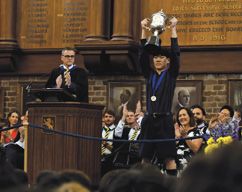
Old Boy Ben Barclay ‘15 carries the New Zealand flag at the opening ceremony of the 2026 Winter Olympic Games. Full story — page 58 (outside this 10-page preview).

Advertisement Shakespeare Orthodontics — advertisement
Editors and writers
Amanda Booth and Jude Dobson
Phone / Email
09 623 5400 ext 576 · j.dobson@ags.school.nz
Contributors
Murray McKinnon ‘59, Peter Stanes ‘58, Dominic Gasparich ’18 and the School’s Media Group
Proofreaders
Jim Espie ‘38, Mary Farrell, and Fiona Geary
Cover image
Zoi Sadowski-Synnott and Old Boy Ben Barclay ‘15 carry the New Zealand flag at the opening ceremony of the 2026 Winter Olympic Games
Design
PK Malkamaki (Great North)

Contents

Old Boys’ News

  • 51The President’s Report
  • 52Anzac Day
  • 54Augusta Award Nominations
  • 56Old Boys’ News
  • 63History
  • 64International Old Boys’ News
  • 66Grammar Families
  • 68Obituaries
  • 72From the Archives

Greyed-out pages aren't part of this 20-page preview.

Headmaster Tim O'Connor
Reflections

Reflections by the Headmaster

“Grammar’s school culture permeates the School daily, starting with the full School assembly.” These few words were part of my first impressions of Auckland Grammar School, shared in my first Ad Augusta editorial in May 2013. Tim O’Connor, Headmaster
Full copy in progress

The rest of the Headmaster's editorial wasn't drafted yet in this working version of the export (12 March 2026) — the flat plan lists page 4 as an image and page 5 as a pending "report".

Board Chair Grant Trethewey
Board Report

Report from the Board

On behalf of the Board, I welcome all students for the 2026 academic year, not only the Form 3 cohort commencing their time at the School, but also those who are returning to continue their education. We look forward to your contributions across all aspects of curricular and extracurricular activities available at Grammar.

I would also like to welcome the wider Grammar community, particularly those parents embarking on their time at Grammar with their sons. Your support will help to ensure you enjoy the experience of being associated with Grammar, which strives to make opportunities available for your sons.

Once again, we have a very large Form 3 cohort, in excess of 500, which contributes to a total school roll of more than 2,800. With the continuing demand for places at the School and the Government and local authority focus on intensification in the School zone, the roll must be managed on a year-by-year basis, given that we are obliged to take all eligible students from within the Grammar zone.

The Board continues to review the effects of current enrolment legislation on our ability to operate the School at the high standards we strive for, whilst ensuring compliance with the requirements of health and safety standards to ensure the well-being of students, support staff and teachers. This is becoming increasingly difficult given the current and forecast growth for Auckland and the potential implications of the plans for intensification in the Grammar zone. We continue to discuss these issues with the Ministry of Education, both at an official and political level to ensure that the School can continue to maintain its long-standing values and quality of education.

In 2025, the School achieved outstanding academic results and, in a key indicator, had a University Entrance pass rate of 87%, maintaining the School’s primary goal of achieving academic excellence. The Board believes it is important to provide the best environment for our teachers and students to push these achievements to higher levels as the School continues to grow. To do this, we are endeavouring to build upon the excellent foundations already in place, both in terms of teaching facilities and the quality of teachers.

A major initiative in terms of maintaining and enhancing the School’s primary focus on academia, and the teachers required to support that focus, is the ongoing strategy of growing and managing the School campus to provide options for improved facilities for teachers and students, including the option of further housing for teachers.

To that end, the proposed purchase of 10 Clive Road and the ongoing funding to achieve that acquisition will provide the School with further space in the form of a 2,000 square metre property adjacent to Tibbs House. This acquisition will provide the School with additional options, including the ability to offer more housing to assist teachers to overcome one of the major constraints for teachers at Grammar.

The purchase of 10 Clive Road will require extensive support from the wider Grammar community. I would like to thank those who have already contributed and to encourage those in our Grammar community to also become involved in what is a long-term project to assist in ensuring the future successful growth of the School.

Per Angusta Ad Augusta.
Grant Trethewey ‘76 — Board Chair

Lead Feature

High Purpose and Deep Belonging

The intersection of identity and education

“Education is not just about the acquisition of knowledge; it is about the provocation of being in the world in a grown-up way. It is the beautiful risk of becoming a subject who acknowledges they are part of something larger than themselves.” Professor Gert Biesta

Professor Gert Biesta is a world-renowned educational philosopher and author whose work challenges schools to move beyond “learning” toward the cultivation of human character and responsibility. His educational philosophy explores how purpose and belonging empower students to become themselves — a philosophy embraced by Headmaster Tim O’Connor.

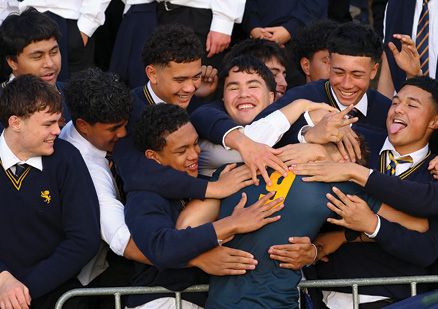
Headmaster congratulates a student at an awards ceremony Students celebrating a rugby win

Headmaster Tim O’Connor has a bookshelf packed with inspirational reading material. On there you will find the work of Professor Gert Biesta, whose educational philosophy is of great interest to him. “In the modern educational landscape, it is easy to get lost in ‘how we learn’ (the process), and Biesta prompts educators to reflect on ‘the what’ (content) and ‘why’ (purpose) that is needed to help create a high-purpose environment in which our students can thrive.”

Biesta suggests that we are in danger of turning education into a simple transaction where students are consumers and teachers are merely facilitators. He describes this as “learnification,” which he says is simply not good enough.

He argues that schools must balance academic results with the development of a student’s unique character within a high-purpose environment. Biesta says the environment must do three things simultaneously to succeed: Qualification, Socialisation, and Subjectification.

Qualification

A school of excellence must master qualification, which Tim notes has always been central to a Grammar education. “The School has the necessary academic rigour in place to provide students with the credentials to navigate the world.”

Socialisation

Tim says that Biesta points to the necessity of the environment to provide a profound sense of belonging. “With socialisation he talks about the need for students to be initiated into a specific tradition, a lineage of values, and a community that cares for their development, and this is something we see as absolutely key at Grammar.”

This ‘belonging’ is not about blind conformity; it is about providing the stable ground upon which a student can stand and feel part of a community they feel they can excel in.

Tim references another well-leafed through book in Owen Eastwood’s ‘Belonging’. “Eastwood tells us that deep belonging creates a profound sense of psychological safety and identity that allows someone to shift from survival mode into the higher-level cooperation and risk-taking required for elite performance. We want boys to feel a keen sense of belonging at Grammar.”

Subjectification

Subjectification, Biesta says, defines the soul of a high-purpose school. This is the process of a student becoming a ‘subject’ of their own life, rather than merely an ‘object’ of educational interventions — the learner or the consumer. They become more autonomous and independent in their thinking as individuals.

For Biesta, Tim says, “the ultimate purpose of an educational environment is to help individuals exist in the world in a ‘grown-up way.’ This doesn’t mean being an adult; it means existing in a way that acknowledges that they are not the centre of the universe.”

The Teacher as “Interrupter”

In a high-purpose environment, Biesta says the teacher is not just a ‘provider of learning opportunities.’ They are someone who provides high-quality input, frequent response opportunities, and rigorous feedback. In doing so the teacher ‘interrupts’ the student’s current way of being. This interruption is an act of care. It signals to the student: “I see you, I believe you are capable of more, and I am calling you into a higher way of existing.”

Tim encourages his staff to ‘interrupt their subjects.’ “When we focus on seeing every student, regardless of their stream, as a ‘subject’ in waiting, we create the conditions for excellence. It is through the quality of our relationships with them and the depth of our purpose that we can support their growth here at Grammar.”

A high-purpose educational environment is a deliberate architecture. It requires the ability to provide qualification, furnish a community to socialise in and belong to, and gives the opportunity for students to ‘grow up’ within this structure with some ‘intentional interruption’ from their teachers to help them excel.

Left: Belonging in practice — a 1st XV player is engulfed by students on the sideline. Right: Headmaster Tim O’Connor congratulates Head Prefect Nico Stanley as he crosses the stage at the first assembly of the 2026 academic year. Opposite: the daily assembly for the whole School in the Great Hall.

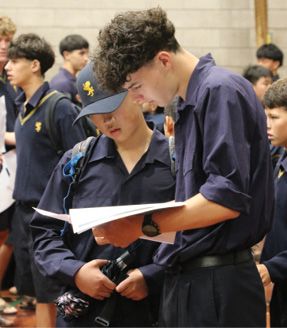
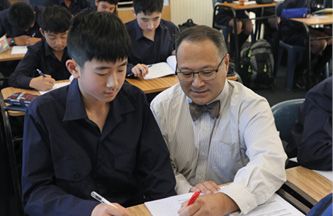
A teacher showing a book to two students in a French class
Academic

A second year for learning a second language

Anyone who has started the journey of learning a second language will tell you it takes time. As of next year, Auckland Grammar School is going to give students more time to cement their learning in a second language, by making their language choice a compulsory two-year course rather than just a single year in Form 3.

Head of Faculty for Languages, Carlin Shaw is pleased the School has taken this decision. “Not all schools make a commitment to helping to build more balanced students by making learning a second language a part of everyday school life. Grammar has deemed this important to a young man’s learning and given them the opportunity to get a good grasp of their chosen language.”

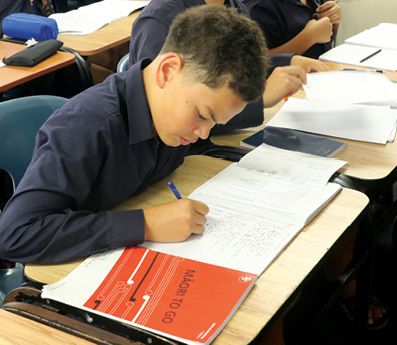
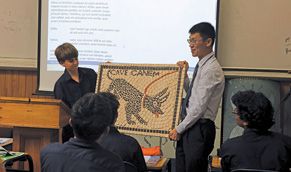
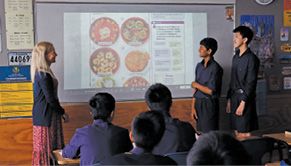
A student writing in a notebook during a Te Reo Māori class A Latin teacher holding a tapestry with a dragon on it A Spanish class in front of a projector screen

The five languages on offer remain as French, Japanese, Latin, Te Reo Māori and Spanish. In learning them, a student learns far more than how to read, write and recite a language that has hitherto been foreign to them. Carlin says it enables them to gain a different perspective on life. “Language is deeply intertwined with culture, and learning another tongue breaks down stereotypes and builds empathy. When a student studies Māori, for example, they gain insight into te ao Māori (the Māori world) and tikanga (customs), expanding their understanding of local identity. Likewise, Spanish and French provide windows into diverse global communities and histories, while Latin provides a basis for understanding European language, structures and thought. Japanese society and history are fascinating and their pop culture storytelling through ‘animanga’ (anime and manga) is well known.”

This exposure to a culture different from their own can help a student move away from a monocultural mindset, foster tolerance and gain a genuine appreciation for diversity. These are traits that are imperative in an increasingly interconnected world, particularly when you live in a borderless island nation, far from the countries that speak those languages.

“If you talk to a man in a language he understands, that goes to his head. If you talk to him in his language, that goes to his heart.”Nelson Mandela

Spending time mastering a second language, Carlin notes, can also have a useful effect on the other subjects a student is taking. “It engages students in critical thinking, which can strengthen their performance across the board.” Studies have shown positive correlations between second language learning and academic achievement. Research also shows that being bilingual can lead to improved listening skills, since the brain has to work harder to distinguish different types of sounds in two or more languages. Furthermore, a growing awareness of the abstract rules and structure of a second language can also make someone more cognisant of the rules around their first language.

Multiple studies over time have concluded that learning a new language makes a difference to the way your brain develops and functions. The better you learn, the more those vital areas of the brain grow. While this is well documented in children who grow up in a bilingual environment, there are still proven neurological benefits for adults of any age learning a second language.

Having new experiences is an important factor in forming new connections in the brain. The novelty of a new task, combined with the repetition of practice, is one of the reasons that language learning is such an effective brain workout. For older adults it is considered a protective factor against dementia and other degenerative neurological conditions.

As a young person entering a competitive job market, Carlin suggests having some knowledge of a second language and its culture is an advantage. “In a globalised economy, employers are increasingly seeking staff who can bridge cultural and linguistic divides. Learning another language prepares students for international opportunities, whether in business, diplomacy, or travel. In a local context, learning Māori helps build a stronger, more inclusive community by fostering respectful, cross-cultural connections.”

By offering a two-year course in their chosen language, Grammar students will have the opportunity to engage with both living cultures and foundational linguistic structures for a longer period. Carlin believes the class of 2027 and beyond will benefit from this change. “I think it is a move that will be good for our young men on so many levels.”

1) Form 4 student Tautahi Stone works on his reo; 2) Latin Teacher Michael Dong and Form 4 student Sebastian Harvey discuss ‘beware of the dog’ in Latin; 3) Head of Department – Spanish Michelle McNeill talks food with her class. Opposite: Marie Gaspar with her Form 4 French students.

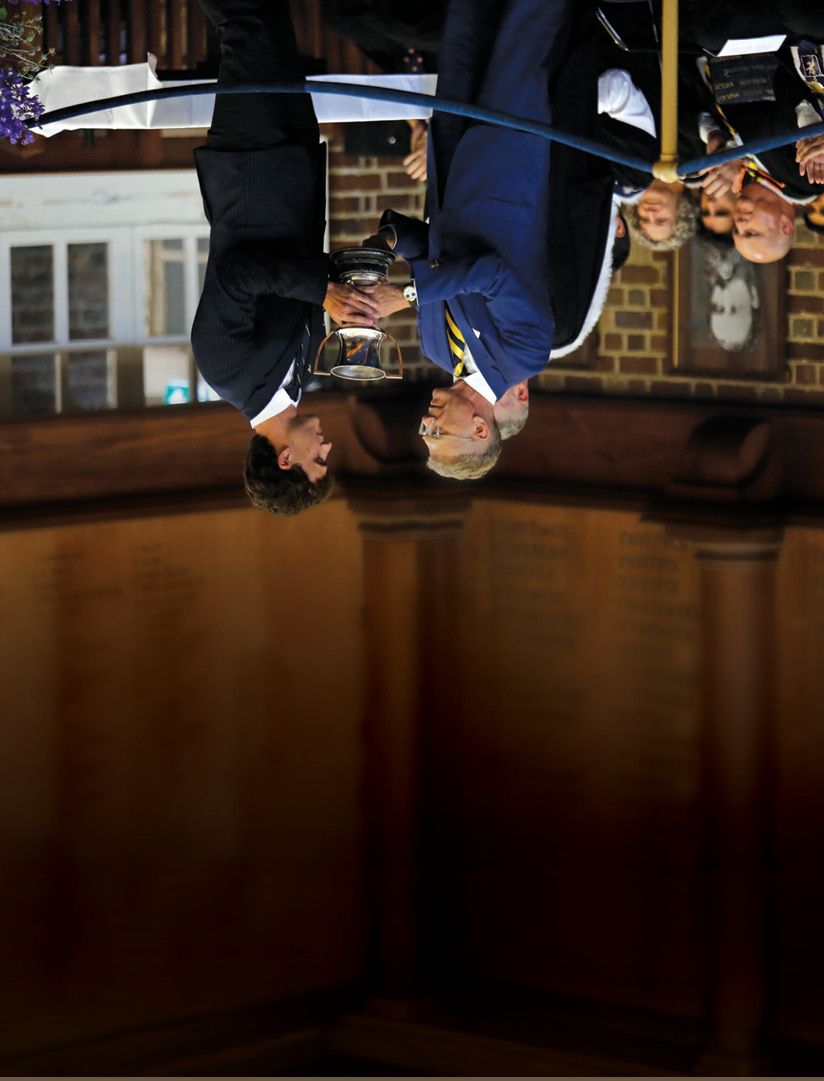
A man holding a trophy shakes hands with another man
Character Education

Becoming a Good Grammar Man

At Auckland Grammar School, ‘The Grammar Way’ is at the very heart of the School’s ethos. Often quoted, it is not just a saying, it is a way of being.

By weaving Grammar’s seven core values of integrity, service, respect, resilience, humility, commitment, and courage into the fabric of daily life at the School, Grammar provides a moral compass for the students in our care.

The nurturing and demonstration of the collective standard that encompasses ‘The Grammar Way’ is there to help transform teenage boys into cognisant, principled and determined young men. As they enter adulthood, we want Grammar men to embrace challenges and uphold the values of a good man in all aspects of his life.

A group of students standing in a line A group of people hugging on a beach

An education at Auckland Grammar School provides more than formal qualifications. It should furnish a young man with an education in good character.

In his inaugural report in 1954, the School’s eighth headmaster, Sir Henry Cooper, identified that “the School seeks to graduate boys with valuable gifts of temperament and character...and men of quality.” His wish was for them to “have developed a healthy attitude to life...and it is on their efficient work and loyalty and their appreciation of their obligations as citizens that the well-being of the country depends.”

Over 60 years later, this vision still stands, albeit in a 2020s context. Sir Henry Cooper’s aspiration has since had much thought and structure put around it, which eventuated in ‘The Grammar Way.’

Auckland Grammar School is anchored by seven core values that form the foundation of ‘the Grammar Way.’ These values are designed to guide students’ behaviour and character development.

The School integrates these seven values into daily life, from assembly addresses by the Headmaster and teachers’ expectations in the classroom, to knowing what conduct is expected on the sports field or sideline and at any time a student is seen in uniform outside the school gates. The goal is to graduate young men of good character.

Becoming a good man, through the lens of ‘The Grammar Way’ focuses on these seven values and their “student-speak outcomes”, noted below:

Integrity

Demonstrating integrity means having strong moral principles and acting in accordance with them. “We support our mates and do what is right, even when no one is looking.”

Excellence

Excellence comes from a determination to acquire knowledge and skills of the highest standard. “We put in the hard yards and keep our standards high.”

Respect

Respect means having due regard for the feelings, rights and wishes of others. ”We treat others how we want to be treated and give respect to receive respect.“

Courage

It takes courage to face challenges and discomfort. “We stand up and stand strong for what we believe in.”

Pride

Pride means having satisfaction in our achievements. “We are not afraid to be ourselves and are proud to wear the Lion.”

Commitment

Commitment means being dedicated to a cause. “We live up to our promises, and we never give up.”

Humility

Someone who demonstrates humility has a modest view of their own importance. It involves acknowledging the contributions of others and being a ‘quiet achiever.’ “We are the ‘bigger man’ and are willing to learn from others.”

If living by ‘The Grammar Way’, a Grammar man can answer his question of, “Who am I?” He is a man with a sense of whakapapa. He understands his identity and his heritage and knows the values that shape him. He takes responsibility for his actions and strives for personal growth.

If he asks himself, “Where do I fit in and how can I best serve others?” he can answer that question too. He has a sense of tūrangawaewae, and understands his place in the world. He embodies whanaungatanga, contributing positively to those around him and makes a lasting impact. He leads with humility, service and integrity. He is a good man.

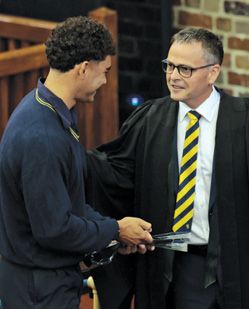
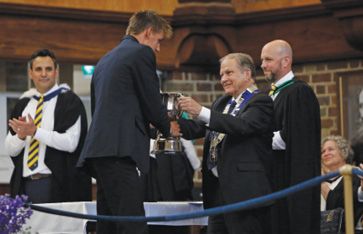
1) Form 7 student Lachlan Cameron helps a Form 3 student on the first day of school in 2026; 2) A group of Duke of Edinburgh Award boys enjoy time together at Piha on their Bronze Practice Journey. Opposite: 2025 Rope Cup recipient James Hiddleston ‘21 accepting the cup from Government Minister Hon. Paul Goldsmith ‘84 at the 2025 Prizegiving.

Drone photo of 10 Clive Road and the surrounding Grammar campus
Lead Feature

Why 10 Clive Road is an important legacy project for the Grammar community

Every so often an opportunity arises that simply can’t be missed. The chance to buy 10 Clive Road is one such moment. Situated directly adjacent to existing school-owned land, No. 10 offers a rare chance for Auckland Grammar School to expand its presence along Clive Road.

The legacy this piece of land will provide is the ability to future-proof the campus by providing an opportunity to grow the Grammar precinct. This strategic purchase for the School needs the wider Grammar community’s support to make it happen. Once secured, the possibilities are exciting. Headmaster Tim O’Connor sets out his vision for what that could be.

10 Clive Road is a 2000m² site that runs between Clive Road and Castle Drive. It adjoins 8 Clive Rd, already owned by the School. With No.8 neighbouring Tibbs House (the School’s boarding establishment), the addition of No.10 provides a contiguous land holding.

Neighbours who are neighbourly often talk over the fence and catch up with each other’s lives. It was over one such neighbourly chat in late 2024 that Headmaster Tim O’Connor heard from Norma Willis that she was thinking about selling her home of 54 years at 10 Clive Road and wondered whether Grammar might like to be the new owner.

It was not a spur of the moment thought. It was something Norma had thought long and hard about and concluded it would be the best outcome. “I wanted Grammar to have it. I have always had a great admiration for the School and it seemed like a very logical thing to me, for this property to become part of Grammar.”

Funding the purchase

Tim’s reaction to Norma’s proposition was a positive one; he just needed to figure out how to make it happen. As is the way at Grammar, there are always wise heads available to consult about possibilities, and there is always a way forward. ‘No’ is simply not an option.

The solution to taking up the opportunity came about with a generous offer from an Old Boy to pay the $1.5 million deposit. Another Old Boy offered to pay the balance of the purchase price to purchase the property himself in the interim, so that Norma could move out and move on with her life. The generosity of these two men ensured the property did not go to the open market but was instead secured.

It also gave Grammar time to raise the funds to pay back the temporary owner of the house. If the purchase price can be paid back in full by the end of 2026, the property will be transferred into a trust entity at Auckland Grammar School.

Jeff Blackburn, Director of Advancement, has been pleased with the fundraising support to date to ensure the house comes into the School’s possession. “The Grammar community understands this is an opportunity that cannot be missed, and to that end a handful of generous donors have enabled us to reach the $1 million repayment milestone we needed to meet at the end of 2025.”

However, 2026 he says is another year, with the remaining fundraising target to reach, to guarantee that the School can own the property, come year-end. “The figure we need to raise this year is almost double what we raised last year, at $1.91 million.” With just over $600,000 raised towards that goal in the first three months of the year, the momentum needs to continue to find the remaining $1.3 million by December 2026.

Headmaster Tim O’Connor acknowledges the enduring commitment of the Grammar community to actively make the campus their own, decade after decade. “As we have done in the past, with the impact of motorways, pools that are no longer fit for purpose, libraries, theatres, pavilions and the like, we take control of our own destiny through the active engagement of our community, feeding forward to provide us with the Auckland Grammar School we have today. It is now our turn as we look ahead to provide future students, staff, headmasters and boards with the legacy purchase of 10 Clive Road, and the enormous amenity that will bring.”

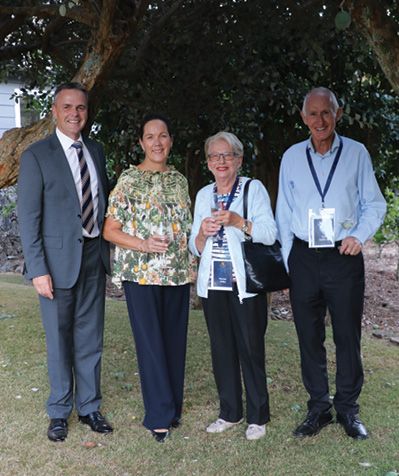
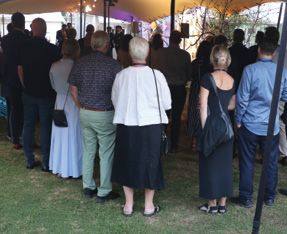
On a summery evening in March, in the ample back yard of No. 10, Headmaster Tim O’Connor took the chance to outline his vision for the addition of the property to the campus to assembled guests. “Job one, is of course to secure 10 Clive Road, so it doesn’t go back out onto the open market. If we don’t get it, it’s gone and we’ll never get another opportunity to purchase this strategically positioned piece of land.” Given that unthinkable outcome, he encouraged the audience to not only actively consider donating to the cause themselves, but to champion it to others in our community.

Learn more at ags.school.nz/10-clive-road →
Lead Feature, continued

The vision of a Grammar precinct

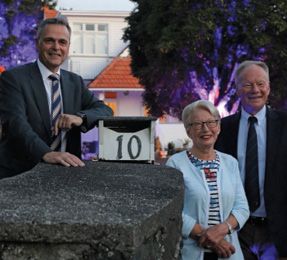
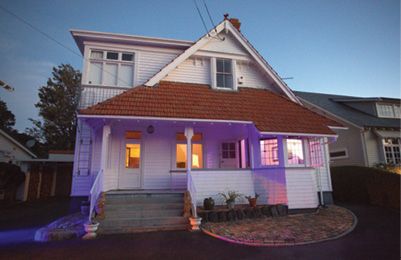
Tim O'Connor, Norma Willis and Grant Trethewey at the gate of 10 Clive Road The house at 10 Clive Road
Guests gathered at 10 Clive Road
Guests at the 10 Clive Road event Guests at the 10 Clive Road event

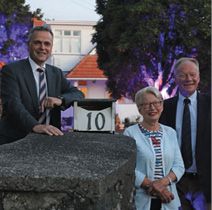
1) The assembled crowd under the marquee on the vast back lawn. 2) Headmaster Tim O’Connor discusses his vision for a Grammar Precinct on site at 10 Clive Road. 3) Left to right: Headmaster Tim O’Connor, Anne O’Connor, Norma Willis (previous owner of No.10) and her nephew Tim Willis ‘65.

“Job two”, Tim went on to explain, “is to develop the detailed vision — an aspiration for a new Grammar precinct. That is, the dream use of Tibbs House land and buildings, 8 Clive Rd land and residence and its neighbour 10 Clive Road.” Between them, No. 8 and No.10 equate to 3000 square metres of land, a sizeable portion of land in central Auckland. The proximity of Tibbs House provides possibilities when the three properties are viewed collectively.

Tim describes ‘a Grammar precinct’ as the most apt terminology for the amenity that 10 Clive Road would add. “Going forward, roll size or demand for places at Grammar will not diminish. Our roll is at its largest in our history, at almost 2800. This year we have a cohort of 564 in Form 3, a 5th Form of 608 students and a 7th Form with 490. We are in unprecedented times.” The growing roll means more teachers, more students and more boarders.

Staff housing

Staff wanting to live in the Grammar zone to ensure they are within a reasonable commute to work are committing to high housing costs, which Tim spells out is challenging on a teacher’s salary. “Going forward, I can’t see that the cost of living in the Grammar Zone will decrease. Living in Auckland outside the zone is also expensive, and there is no ‘Auckland allowance’ for a teacher — they are paid the same as a teacher in Invercargill.”

While the School’s charitable entity in the Foundation Trust offers some extra financial reward through the (competitive) Staff Awards at year-end and a modest donation towards the time spent in extra-curricular support of students, it is the possibility of subsidised housing that is hugely helpful to Grammar teachers.

Tim hopes that a Grammar precinct could provide townhouses for teachers at the 10 Clive Road site and through the back of Barnett Crescent, creating much more staff housing in the available footprint of land owned by the School.

The need is evident with an ever-growing waiting list for the 17 rent-subsidised staff houses on Barnett Crescent and along the northern side of Clive Road. Appropriate housing is not only an excellent way to attract and retain good teachers to teach at Grammar. Their proximity to campus enables them to be closely involved in the day-to-day life of the School.

Tim paints the picture of what a typical morning looks like on the Grammar campus with staff involvement in activities well before the assembly bell rings. “In this past week, if you walked across the campus, before 7am you would have seen the likes of Mr Adam and Mr Trott leading cricket practices, and Dr Etty, Ms Greenslade, Ms Gaspar and Mr Lowe leading the ‘Learn to Row’ programme. You would have seen Mr Askew and Mr Rainger running members of the 1st XV while Mr Du Sart had others in the Weights Room, and you would have seen Mr Oates preparing boys for the Auckland Championships. That’s all before you arrive at Te Ara Mātauranga or onto the B Floor for Maths tuition.” Tim strongly feels that having more staff housing will be a fundamental requirement for the School going forward. “If we are to retain the essence of Grammar, we need more passionate teachers living close by, so their job is achievable and rewarding.”

Tibbs House

A Grammar precinct also involves the development of boarding. The current capacity for Tibbs House is 124 boys, but as Tim muses, “What is the ideal number for Tibbs? What if we could develop two separate boarding establishments on campus, each with 90 students, and they share a common dining hall?”

Then there are the questions about how best to prepare Form 7 boarders for the next phase of their lives. “What if we could provide our Form 7 boarders with flat-style accommodation so we can prepare them even better for independent living? What if we could have each of our boarders leave knowing how to cook five basic meals?”

Providing better spaces and amenities for boarders is not the only item on the wish list for Tibbs House. The accommodation for boarding masters needs to be addressed in any expansion plans. The current accommodation has a maximum of two bedrooms which precludes boarding masters with growing families. Having families live at Tibbs House provides a different feel to other boarding establishments at other schools and this is to be encouraged. “What does a new precinct look like where teachers and their families are part of a wider boarding community? While Auckland Grammar School is a school with boarding, rather than a boarding school, could we find some middle ground?” Tim muses.

A legacy that leads the way

Whatever the precise use of 10 Clive Road eventually is, it is the wider use of the various land holdings — either contiguous or proximal — that is important. Grammar has always strived for excellence in any endeavour, and, as Tim reflects, the 10 Clive Road legacy project is no different. “Why could we not lead the way? Why would we not create a Grammar precinct that attracts engaged and committed students and skilled, passionate practitioners (and their families) who are truly rewarded for the surplus value they provide to generations of Grammar boys? No. 10 symbolises our aspirations for the future of Grammar. If we are to protect the essence of a Grammar education in 10, 20 and 50 years’ time, we need to begin accepting responsibility for this now.”

The concept of ‘feeding forward’ is not new to the Auckland Grammar School community. For over 150 years the community of the day has supported the School to flourish not just for the time period they are in, but for future Grammar communities. Tim’s timeline to the assembled crowd on the back lawn at No.10 encompassed a sizeable list of changes to the campus, which have often been supported financially by the community.

“From the act of moving from Symonds Street to Mountain Road, the international architecture competition to design our main building, to the donations that made the war memorial a reality at the front of the School campus, being extended to the corner of Mountain Road and Clive Road to introduce boarding, the land exchange in 1963 that allowed the development of the motorway and the introduction of the lower fields and of course the purchase of corrections housing in 1994 that introduced the provision of teacher housing, followed most recently by the donation of the tennis courts in Clive Road — this all amounts to Grammar being an exceptional community asset.”

The focus now turns to securing 10 Clive Road. This key property will provide opportunities to anchor Tim’s vision for a growing Grammar precinct in the neighbourhood. “Grammar has enjoyed a strong presence in Mountain Road and Clive Road since 1916, and that presence will not diminish. Instead, through a Grammar precinct, it will become stronger.”

Making the purchase possible

To contribute to the purchase of 10 Clive Road, please contact Jeff Blackburn ‘67 or Daniel Reddish.

Jeff Blackburn
021 912 753 · j.blackburn@ags.school.nz
Daniel Reddish
027 314 6448 · d.reddish@ags.school.nz
Learn more at ags.school.nz/10-clive-road →
Student Leadership

Student Leadership

2026 Head Prefect Nico Stanley’s first speech to the student body was one of inspiration and dedication to the year ahead.

To start off, I would like to extend my congratulations to the Prefect cohort for 2026. This is a huge achievement and it speaks volumes about your character and your commitment to the School over the last four years.

I know that I, alongside Deputy Head Prefect Matayas Thomson and Senior Prefects Rupert Glaetzer and Xavier Clark, am extremely excited to work with you all and lead the School with pride. You have all earned this role, but what matters now is how you carry it — lead with humility, set the standard every day, and remember that your actions will always speak louder than the badge.

The start of a new year always brings a sense of expectation. New classes, new challenges, new opportunities. But more than that, it brings a question that every one of us needs to ask ourselves. What am I going to make of this year? I ask that you really think about this question and think about what you can do differently this year to maximise your potential. What can you do to be a contributing Grammar man? What can you do to get the most out of 2026?

At Grammar, we talk a lot about excellence, whether it be academic, sporting, or cultural. But excellence doesn’t happen by accident. It comes from setting clear goals, committing to them, and having the discipline to follow through when things get hard. I challenge you to set clear goals for this year — no matter how big or how small. Whether it’s achieving a certain standard in your exams, making a sports team or simply stepping out of your comfort zone to make new friends — having something to work towards gives direction and purpose.

If I have learnt anything over my four years at Grammar, it is that this school rewards hard work, like in most things in life you get out of it what you are prepared to put into it. There is no doubt that at times it can be challenging, and the pressure is high.

I have been fortunate enough to be a member of the 1st XV Rugby team over the last two years — a team that teaches you that pressure is a privilege. During these times of high pressure, I have realised that it reveals two kinds of people — those who let it limit them, and those who use it to rise to the occasion.

What person will you be? Whether it is through exams, musical performances, matches, or expectations, pressure is part of life at Grammar. There is always a choice with how much effort and hard work you are prepared to put in. This lesson applies whether you are wearing a rugby jersey, wielding a hockey stick, or simply wearing the Grammar uniform.

What defines us as a school is not how we perform when things are easy, but how we respond when they are hard. In Belonging, Owen Eastwood explains that strong groups perform best when individuals understand where they come from and the responsibility they carry for each other. Belonging is not passive — it is earned through contribution, standards, and shared values.

At Grammar, belonging means understanding that you are part of something far bigger than yourself: a tradition built by generations before us, and a culture that depends on how we act today. When we hold ourselves and each other to high standards, we create an environment where people feel supported, accountable, and able to perform.

To the Form 7 cohort, I trust that you will make the most of your last year at Grammar and be the example. Although it is our last year it is not the time to slow down but rather speed up and continue learning and growing. So, finish strong and make sure you have no regrets about your final year when you walk through the School gates for the final time.

So to finish, remember that excellence comes from effort, pressure is a chance to rise, not something to avoid, and belonging is earned through contribution, standards, and service. If we commit to these things, we strengthen not only ourselves, but the culture of this school. Stand tall, be proud, be united, and let your actions reflect what it means to be a Grammar man.

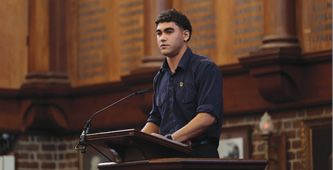
2026 Head Prefect Nico Stanley addressing the student body

2026 Head Prefect Nico Stanley in his first address to the student body.

Watch the speech ▸

2026 Prefects

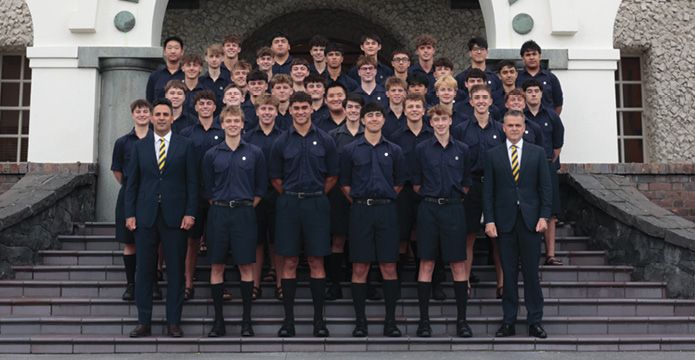
The 2026 Prefect cohort

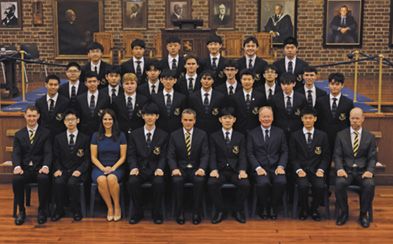
Above: the 2026 Prefect cohort led by (front row from left) Deputy Headmaster Pastoral – Senior School Neitana Lobb, Senior Prefect Rupert Glaetzer, Head Prefect Nico Stanley, Deputy Head Prefect Matayas Thomson, Senior Prefect Xavier Clark and Headmaster Tim O’Connor.

N. J. StanleyNico (Head Prefect)
M. D. H. ThomsonMatayas (Deputy Head Prefect)
X. R. ClarkXavier (Senior Prefect)
R. S. GlaetzerRupert (Senior Prefect)
J. E. G. BaillieJack
S. P. R. BeggsSamuel
J. D. BethellJacob
L. M. BlandLuca
M. M. BrowneMax
J. E. R. BuchananJohn
L. M. CameronLachlan
H. Y. Y. CheungHaydn
C. J. ClarkConnor
T. A. L. CurteisTom
C. A. DunwoodieCampbell
M. C. EvansMichael
M. B. FrostMorgan
J. A. GowingJoshua
E. C. HalaapiapiEthan
R. J. A. HalsteadRiley
T. C. HeatherTheodore
F. W. HillFinn
A. R. HollandAria
J. J. HunterJasper
M. K. JacobsMarlee
R. D. JohnsonRiley
T. R. KingToby
A. KumarAarush
B. S. LucasBen
M. MaMaskil
N. E. MackayNoah
L. F. MatuschkaLuke
J. S. McNaughtonJoshua
O. S. X. QinOscar
J. R. RowbothamJoshua
R. ShenRuyue
J. A. SmithJoshua
B. A. StaffordBen
M. V. M. TaylorMarcus
R. T. Te TamakiRyland
L. C. R. ThomsonLuke
J. A. W. ThorpJoshua
N. H. S. ThorpeNikau-Te Ha
E. E. J. TuatagaloaEric
T. J. WentThomas
T. S. S. WilliamsThomas
A. J. G. WorthAlexander
D. YuDaniel
B. M. ZameBart
More on Student Leadership →
Academia

An Overview of the 2025 Academic Results

The 2025 academic results were very pleasing, with senior students performing extremely well in all external assessments.

The Cambridge examination performances, particularly for A Level, were very strong. The percentage of A* and A grades were 41.4%, with the overall pass rate sitting at 98.8%. The AS results were also fantastic, with the A-C pass rate exceeding almost 69% and the overall pass rate at 95.8%, the most successful pass rate for the past eight years. This represents an exceptionally strong performance in one of the world's most academically demanding secondary school qualifications.

The School's NCEA cohort also performed very well. At NCEA Level 2, 69% of students gained their certificates, with 25 students gaining their certificates endorsed with Merit. At NCEA Level 3, 83% of students achieved the qualification, and 19 students had their certificates endorsed with Merit. Over 645 of NCEA Level 3 students achieved University Entrance in 2025.

Auckland Grammar School students study predominantly rigorous, academic subjects and standards which lead to comparatively high University Entrance rates for the Form 7 cohort. Cambridge students achieved a University Entrance pass rate of 99.6% in 2025 (up 0.3% from 2024), and the NCEA Form 7 cohort achieved 64.4% (up almost 5% year-on-year). Combined, the Form 7 students in 2025 achieved a University Entrance pass rate of 85.7%.

In 2025, the national pass rate for all students was 49.9% and the figure for all students in the School's Equity Index (EQI) was 70.1%. The 2025 national average for boys in schools in the EQI achieving University Entrance was 62.5%. Across all schools in New Zealand, the University Entrance rate for boys sat at 43.4%.

Auckland Grammar School was once again one of the top three performing schools in the country in NZQA Scholarship examinations, after students earned 198 individual scholarship awards in 2025. These are students from the top 10% of the entire Form 7 cohort, plus Form 6 students from classes 6A and 6B.

2025 Outstanding Cambridge Learner Awards

The list of students who earned Outstanding Cambridge Learner Awards for 2025 was released in February, and Auckland Grammar School earned a collective 15 High Achievement and Top in New Zealand Awards, as well as two Best Across AS and A Level Subject Awards.

Current Form 7 student Owen Li Zhang was named Top in New Zealand with Best Across 4 AS Level Subjects, and 2025 Dux Taejeong Kim was named Top in New Zealand with Best Across 3 A Level Subjects.

Six Top in New Zealand Awards were gained by Leo Briggs (A Level Design and Technology), Tony Chou (A Level English Literature), Maxwell Clarke (AS Level Physics), Harry Fan (AS Level Chemistry), current Form 7 student Toby King (AS Level Economics) and Ao Ran Liu (AS Level Biology).

Seven High Achievement Awards were given to students who were Top in New Zealand but in subjects with limited entries: Harry Fan (AS Level Economics), Charles Fearon (AS Level Geography), Aaryan Maganlal (AS Level English), Scott Moore (AS Level Accounting), Xiao Shen (AS Level Business Studies), Aoxuan Yu (A Level Digital Media and Design) and Gary Yuan (A Level Spanish Language and Literature).

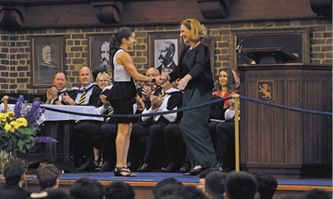
2025 Dux Taejeong Kim is congratulated at the annual Prizegiving ceremony

2025 Dux Taejeong Kim is congratulated at the annual Prizegiving ceremony in the Great Hall.

2025 Dux — Taejeong Kim

The B. F. Connell Prize for Dux of the School was awarded to Taejeong Kim, whose senior academic career has been defined by his exceptional capabilities and scholarly achievements. Originally from Korea, Taejeong started midway through Form 4 and finished at the top of 7A.

In the end-of-year A Level examinations, Taejeong secured an aggregate of 384/400, placing him first in Class in each of his four A Levels and also first in 7A — 93% in Biology, 95% in Chemistry, 96% in Physics and 100% in Maths. He also received the Rabone Prize for Form 7 Science and the O'Sullivan Prize for Biology. This year, he begins a Bachelor of Medical Science at Monash University in Melbourne.

Watch the Dux address ▸
The 2025 University Entrance Scholars

The 2025 University Entrance Scholars, photographed at the annual Scholars' Assembly.

2025 Scholarship Awardees

Congratulations to the 34 students who received their Scholars' certificates and ties from Minister of Education Erica Stanford at the annual Scholars' Assembly in February. In 2025, 89 students gained a total of 198 individual subject Scholarships, including 16 at Outstanding level.

NZQA Scholarships were gained in a range of subjects, including Accounting, Agriculture and Horticulture, Biology, Calculus, Chemistry, Classical Studies, Design Technologies, Earth and Space Science, Economics, English, French, Geography, Health and Physical Education, History, Japanese, Music, Physics, Psychology, Religious Studies, Spanish, Statistics and Technology.

Maxwell Clarke, Aaryan Maganlal, Yuntao Xue and Jiake Zhu were also named as Outstanding Scholars for 2025. Maxwell (8 scholarships including 2 Outstanding), Aaryan (6 including 2 Outstanding), Yuntao (7 including 2 Outstanding) and Jiake (7 including 1 Outstanding) earned a combined 28 individual Scholarships, including 7 at Outstanding level. Maxwell was also named the NZQA Top Scholar in Spanish.

Also named among the 2025 Scholarship Awardees: Eirene Apineru, Louis Delamare, Abdul Razack, Iain Yong, Yuntao (Jerry) Xue, Jamies Hiddleston, Orlando Ko, Oliver Mortimer, Samuel Openshaw, Fergus Williams, Marco Alpe, James Carver, Yusuke Chow, Yu-Hui Chu, Tharindu Kumararathna, Ao Ran (Aaron) Liu, Huanran Qin, Jacob Wong, Tony Chou, Aston Ingram and Minu Park.

Vice-Chancellor's Access Waikato Scholarship — Cooper McCone. Pacific Peoples' Entrance Scholarship — Nathan McNaughton. D. V. Bryant Trust University of Waikato Residential Scholarship — Cooper McCone. Also recognised: Fergus Allan, Lachlan McCourtie, Luca Williams.

Post School Awardees

Auckland Grammar School has an additional 10 awards for recent leavers, of which nine were given out at the end of 2025. These scholarships are awarded based on a number of criteria, including academic excellence and overall character, commencing study within a specific subject, or financial hardship.

Congratulations are extended to Siva Allu (Paul Ma Scholarship), Tony Chou (John Williamson and Dr Ken Rudall Scholarships), Max Heather (Bill Browne and Abbott Watson Scholarships), Taejeong Kim (John Williamson and J. C. Macky Scholarships), Tharindu Kumarathna (Dr Kidd Memorial Scholarship), Aaryan Maganlal (R. M. Grant Memorial and Robert and Freda Narev Scholarships) and Minu Park (Robert and Freda Narev Scholarship).

Minister of Education Hon. Erica Stanford speaking at the 2025 Scholars' Assembly
Academia

2025 Scholars' Assembly

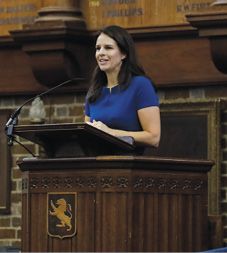
Minister of Education Hon. Erica Stanford spoke at the occasion.

At the 2025 Scholars' Assembly in late February, the Minister of Education, Hon Erica Stanford, was the guest speaker, addressing the 31 students who would soon cross the stage. "It is an incredible feat what the young men who will cross the stage today have achieved, and it is not to be underestimated the incredible amount of hard work, of dedication, of study, of sacrifice, and commitment that went into achieving the results we are here to celebrate today."

The Minister was clear in her recognition of what underpinned that achievement. "It is not just last year that we are celebrating, but the years that led up to that result." From primary school to intermediate through to their time at Auckland Grammar School, the Scholars' success reflects a long-term investment in learning, supported by teachers and families alike.

The Minister spoke of the privilege of an education at Auckland Grammar School. "You are extraordinarily lucky to be at a school like this, that instils in you some incredible values and really presses upon you the importance of academic achievement." She also stressed the importance of the responsibility that comes with it. "There is no greater gift than an amazing education," she said, describing it as something that can "change the trajectory of your life" and open doors that would otherwise remain closed. She also emphasised that it is not qualifications alone that matter. The habits formed along the way — focus, drive, determination, and a commitment to excellence — are what ultimately sets these young men apart.

"Not everybody has that," she observed. "The fact that you do will set you apart from everybody else." Her message was simple: take those attributes and apply them to everything. Even the most modest beginnings, she explained, can lead to unexpected opportunities.

The Minister then spoke about her first role right after graduation from university — she joked that her job was to make coffee and photocopies, "but I made the best coffee and I photocopied the best photocopying." That growth mindset, she explained, led to rapid progression, not because of the tasks themselves, but because of the attitude behind them.

Her advice to the Scholars was to carry that same approach into every endeavour. "Always give 120%," she said. "It will be noticed, and there will be more opportunities that open up for you in life outside of Grammar."

She also addressed the inevitability of setbacks. "I can tell you that along the way, you will fail," she said plainly. "But failure is not the problem. The problem is how you deal with failure, how you pick yourself up, you remember the lesson that you learned and you move forward." What matters, she explained, is resilience — the ability to learn, recover, and move forward with purpose.

Looking beyond the School, the Minister spoke about her wider ambitions for education in New Zealand. Her goal, she explained, is to ensure that every young person has access to the kind of opportunity represented by Auckland Grammar School — a system defined by "high expectations, high aspirations, and high goals." She pointed to ongoing work to strengthen the curriculum, invest in teachers, and raise the standard of national qualifications.

Central to that vision is a belief in equity. She quoted a phrase she heard from the Minister of Education in Singapore, who shared a principle that underpins her approach: "Your means should not determine your destiny." It is, she suggested, an ideal New Zealand must continue striving towards.

She concluded by challenging the Scholars to carry forward what they have gained. "Take what you have learned here," she said, "and make sure you carry that with you in whatever it is that you choose to do." Just as importantly, she encouraged them to remain connected to the School and, in time, to give back — to help future generations understand what it takes to succeed.

The Minister also acknowledged the role of parents, thanking them for the part they have played in shaping the young men celebrated on the day. Their contribution, she noted, is "so very crucial" to both character and achievement.

For those in attendance, the message was both one of recognition and of challenge. Their success deserves to be celebrated, but it is also a starting point. As the Minister reminded them, "you should be incredibly proud of yourselves" — and ready for what comes next.


Advertisement Barfoot & Thompson — advertisement
Sport

Sport Round-up

Rowing crew on the water

Rowing — the Under 18 Senior Eight won Gold at the annual North Island Rowing Championships at Lake Karapiro in late January.

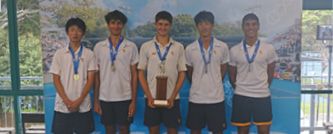
Tennis team

Tennis — the Premier Tennis team ahead of the New Zealand Secondary Schools Championships.

Yachting team

Yachting — the team competing at the Auckland Teams Championships, hosted at the Royal Akarana Yacht Club.

Full write-up in progress
Sport

Summer Tournament Week

…where they were challenged by Hamilton Boys' High School and St Bede's College, who went on to claim Bronze.

Tennis

In their first pool stage match at the New Zealand Secondary Schools Championships, the Premier Tennis team played Christ's College, securing a 4-2 win, making for a positive start to the tournament. Day two saw the team play St Kentigern College — a number of super tiebreak points challenged the team, but they prevailed with a 5-1 victory to progress straight through to the semi-finals. The team played their final pool match against St Andrew's College, winning 4-2 to finish top of the pool, then beat Christchurch Boys' High School 4-1 in the semi-final.

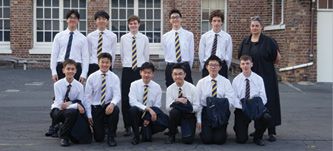
The Premier Tennis team played St Kentigern College in the New Zealand Secondary Schools Championship Final. Multiple super tiebreak points were played, with Ridley Huang losing his singles match by a narrow 6-10 margin in a final set tiebreak. After four matches, the team were 3-1 ahead, with Captain of Tennis Luca Bland securing a straight sets victory (6-2, 6-1). In the doubles, Luca Bland teamed up with Yida Wu to win 6-4, 6-0 — a 4-2 win overall, and a second consecutive National title.

Triathlon

Unfortunately, the New Zealand Schools' Triathlon Championships in Tauranga were cancelled due to extreme wind gusts. The organisers did organise an open-water swim in the sheltered harbour, which Auckland Grammar School students completed.

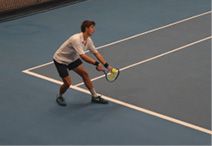
Captain of Tennis Luca Bland serving Premier Water Polo team on the attack

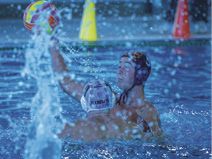
Left: Captain of Tennis Luca Bland prepares to serve a tiebreak point against St Kentigern College. Right: the Premier Water Polo team on the attack against King's College, ending in a draw.

To ensure a fifth-sixth place final, Grammar had to beat Rangitoto College, which they did, winning 9-7. Unfortunately, Grammar started slowly in the fifth-sixth playoff final against Westlake Boys' High School, going down 10-9 to finish sixth.

Yachting

The Yachting team competed in the Auckland Teams Championships, hosted at the Royal Akarana Yacht Club, in light and challenging breeze. The School's Gold team started the final day in third and beat Westlake Boys' High School in the semi-final. The Blue team led the round-robin series throughout and beat Takapuna Grammar School in the semi-final; unfavourable conditions meant the final could not be sailed, so the Blue team were named Auckland champions, with the Gold team finishing second overall. The team, led by captain Thomas Pilkington, received their Auckland Championship medals on the penultimate day of Term 1.


Sportsman of the Year

Caleb Wagener

Caleb Wagener holding a trophy Caleb Wagener running Caleb Wagener cycling

Above left: Caleb Wagener receives the Sportsman of the Year trophy from Old Boys' Association President Murray McKinnon, QSM '59. Centre and above right: Caleb during the World Duathlon Championships in Pontevedra, Spain, where he was crowned World Champion for 2025.

Championships in the 1500 and 3000m, with the National Secondary School event also held the same week. It is in Multisport that Caleb reached the greatest heights. Nationally, he defended his Duathlon title while also winning the Aquathon. Representing New Zealand, he won Gold in the Junior Men's Elite Under 19 race at the World Duathlon Championships in Spain in June to be crowned World Champion for 2025.

Caleb received four Colours awards in Athletics, Cycling, Distance Squad and Multisport. At the 2025 College Sport Young Sports Person of the Year Awards, he won the All-Rounder Award and the World Championship Achievement Award, along with three sporting categories: Athletics Track, Distance Running and Triathlon — and was announced as the Supreme Winner, Sportsman of the Year.

Extracurricular

Debating

The Auckland Seasonal Debating Tournament took place via Zoom in early March. The Grammar 1 team, consisting of senior students Benjamin Liu, Maskil Ma and Daniel Wang, had two wins against King's College and Westlake Boys' High School, with two losses to Rangitoto College and St Kentigern College.

The moots for the day covered the role of TikTok in mental health treatment, long-term disaster management in New Zealand, penalising New Zealanders moving to Australia and the most effective way to generate institutional change as a member of minority groups. All debates were limited preparation arguments.

The Grammar 2 team, consisting of senior students Toby O'Sullivan, YiChen Qin, Cheng Xi Wu and Liam Yeh, also had two wins and two losses, while the Grammar 3 team had a win and three losses on the day.

The teams wish to thank Charlotte Forster, Barbara McGowan, Sam Poole and Reece Wright for their support of the tournament.

Debating team Debating team standing in front of a building

Duke of Edinburgh — Bronze Practice Journey

At the end of March, a group of 85 students spent a weekend in the Waitākere Ranges on their Bronze Practice Journey. Below is a wrap-up of the weekend from Form 5 student Suryaansh Bathula: "Over our short but challenging weekend, we pushed ourselves both physically and mentally across steep bush trails and exposed cliffs. From Little Huia through to Mercer Bay, we navigated difficult terrain, set up camp, and relied on teamwork to manage constantly changing conditions. The hike tested our endurance and resilience in ways a normal school day never could. Being picked up at Mercer Bay marked the end of a demanding but rewarding experience, and we aim to build upon it during our Qualifying Journey in May."

Students on a grassy field Students walking up a stairway A tree branch on the beach

1) Students had to carry all their gear for the two-day/overnight Practice Journey, including food and camping equipment; 2) Students in the Waitākere Ranges with Master in Charge Sylvain Bidet; 3) The rugged beaches of Auckland's West Coast.


Extracurricular

World of Wearable Arts — Arvin Rafiee

Arvin Rafiee's design A model wearing Arvin Rafiee's design on stage Arvin Rafiee with his model

1) Arvin Rafiee's intricate work; 2) Arvin's entry being modelled on stage at the World of Wearable Arts show; 3) Arvin and his model holding his award.

Arvin entered because creating clothing has always been of interest to him since he was young. "Growing up, I've allowed myself to express art and meaning into clothing, making them more like pieces compared to something you'd frequently wear."

Given his interest in the arts, Art as a subject is something he has always enjoyed in his schooling. "It's a way to express anything you feel in fun and abstract ways." Art teacher Justin Boroughs was the person Arvin went to when he first had the idea of entering TOI under Grammar's name. "He supported my idea and when the competition was over, communicated with the School to have it displayed in Te Ara. The immediate support he showed is something I will always be very grateful for."

Justin knows talent when he sees it, saying Arvin is not only gifted at drawing and painting, but is also hugely creative. "He has a well-developed imagination, and thinks in a unique way." That creativity is something Arvin hopes might turn into a career in the future, with a goal of starting his own label one day.


Relay for Life

In mid-March, 40 students from the Interact Group participated in the annual Relay for Life, raising funds for the Cancer Society.

With a 7am start and fuelled by breakfast, students walked the first lap together in silence, providing an opportunity to reflect on family and friends affected by cancer, and to remember those who had been lost. Many students demonstrated remarkable endurance, with several running the equivalent of a half-marathon.

Special thanks go to masters Marie Gaspar, Yasmin Lazarus, Neitana Lobb, Rachel Lory and Mellisa Pennington for their time and support throughout the day.

Students running for Relay for Life A student running
Arts and Culture

Polyfest

Tongan group performance Polyfest performance Polyfest performance Polyfest performance Kapa Haka group performing Polyfest performance Kapa Haka group leader with his parents

1) The Tongan group on stage; 2) The bright colours of the Tongan group's performance; 3) Leader of the Samoan group Bitner Lokeni; 4) Robert Robertson (manaia for the Samoan group) performs alongside Bitner Lokeni; 5) The audience watching the Kapa Haka group's performance; 6) The Kapa Haka group performing with passion and pride; 7) Leader of the Kapa Haka group Nikau-Te Ha Thorpe with his parents Debi and Simon.

…performance of the Mako was almost flawless. It was impressive, sharp, controlled, and disciplined and in doing so, earned second place in the Mako competition. This outstanding achievement is a testament to the boys' discipline, unity, and spirit.

The School's Kapa Haka group performed on the penultimate day of Term 1. The group, led by Prefects Nikau-Te Ha Thorpe and Ryland Te Tamaki, practised consistently during lunchtime, after school and on Saturday mornings to confidently learn a bracket consisting of seven items. The boys were committed to mastering these various items and were very supportive of each other, and were awarded third place for Mau Rākau (Weaponry use).

Congratulations to all students involved as well as Masters in Charge Tala Elise, Carlin Shaw and Pahlavi Timoteo for their ongoing support of the groups.


Big Band & Jazz Combo — National Youth Jazz Festival

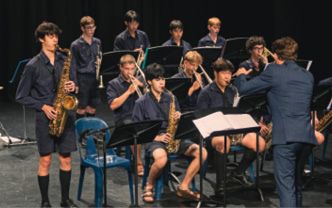
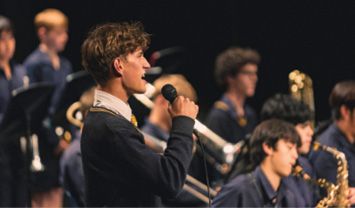
The Big Band performing Vocalist for the Big Band Director of the Big Band A student on drums Leader of the Big Band on trombone

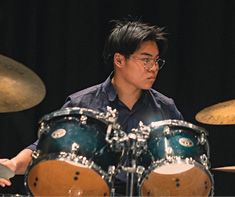
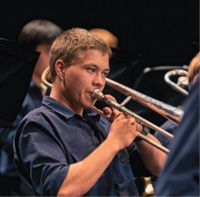
1) Director of the Big Band Elliot Gray; 2) Form 6 student Isaac Yim on drums; 3) Leader of the Big Band Ryland Te Tamaki on trombone; 4) The Big Band during their performance of 'There Will Never Be Another You'; 5) Vocalist for the Big Band Blake Lewis belts out 'Feelin' Good' by Michael Bublé.

Following the Big Band, the Jazz Combo performed a sophisticated four-number set — Caravan, There Will Never Be Another You, Nardis, and Desire. This smaller format effectively highlighted the group's individual musicianship and their collective ability to maintain a steady groove. The adjudicators noted the confident saxophone leadership and the solid foundation provided by the rhythm section, which allowed for fluid improvisation.

Henry Wong acted as the main soloist for the Combo, demonstrating significant creative range across the various jazz standards. The group benefited from a highly disciplined rhythm section, including strong and reliable bass playing from Josh Benson and structured, articulate piano work from Andy Cheng. This rhythmic core was further enhanced by Fernando Montesinos Garcia, who provided several impressive drum solos that anchored the performance.

Congratulations are extended to all students for their dedication and for representing the School so impressively, and to Elliot Gray for his support and leadership of the groups. The results achieved at the National Youth Jazz Festival reflect the hard work of the boys and the music staff during Term 1.

Arts and Culture
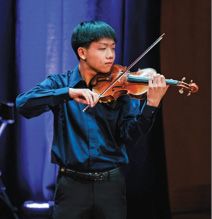
Form 5 student Hayden Chiu on violin Form 4 student Ryah Yeh on cello

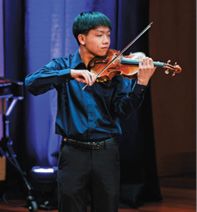
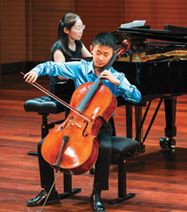
Form 5 student Hayden Chiu on violin (left) and Form 4 student Ryah Yeh on cello.

More about this event →
International Department

From Korea to New Zealand

Students from SiS International Education continue to flourish.

A group of SiS students in Grammar uniform Rachel Fenton at an SiS education fair in Korea Taejeong Kim

David Shin from SiS International Education has been bringing secondary school students from Korea to New Zealand for over 30 years. With offices in Korea, Auckland, Tauranga, Wellington and Christchurch he is well placed to inform families in Korea about the New Zealand education system.

He particularly enjoys telling prospective students and their parents about Auckland Grammar School and why he thinks the School might be a good fit for them. His conversation is plainly memorable, because every year a new group of students from Korea walk through the arches of Mountain Road, ready to start their Grammar journey.

The School's International Relationship Manager, Lee Lim, notes that David brings the most international students to Grammar year on year. "Since 2020 alone, he has successfully placed close to 30 students here at the school, demonstrating his continued trust in us and his strong commitment to matching students with the right academic environment." David's recommendation of Auckland Grammar School is deeply personal. Having graduated from one of Korea's top academic high schools himself, he reflects on his first visit to the School 30 years ago. "When I walked into the Great Hall, I felt an instant connection to my own school days. I recognised the same rigorous academic standards, strong intellectual culture, and long-standing tradition of excellence."

His belief is further reinforced by the success of students who come through the School. Kim Taejeong, a student placed by David, was named the 2025 Dux. Another is Kim Byeongsub, also a David-referred student, who graduated from Grammar in 2016, went on to graduate from The University of Auckland and is now working as a medical doctor in Hamilton.

A great academic reputation is a key, but there is far more to a good education, David says. "This is most definitely a place where students can maximise their academic ability, but what I also like is how this environment values well-rounded men too. Grammar supports our students to grow into confident and capable young men."

The relationship between Auckland Grammar School and David's company SiS is a close and collaborative one. Each year, Rachel Fenton — Director of International at the School — participates in the Education Fairs that David organises in Korea to meet prospective parents and students. When students arrive in New Zealand, David and Rachel's teams collaborate on pastoral care, with the shared goal of growing a great Grammar man.

SiS International Education → International Students at Grammar →
Staff

Farewell to Dr John Etty

After 13 years at Auckland Grammar School, Associate Headmaster – Academic, Dr John Etty is leaving to take on the role of Academic Director at The Teachers' Institute (TTI).

TTI is a provider of initial teacher education, so although John's departure is a loss to Grammar, his expertise is of huge advantage to the wider education sector in New Zealand. "It is important work, and the whole sector can benefit from it. I have become very passionate about the importance of good quality teaching. I am fortunate to have worked with some excellent teachers in my time at Grammar and learnt a huge amount from my colleagues. I hope to pass on some of it to TTI's student teachers so that they don't have to figure it all out for themselves!"

A good teacher has a profound influence on a young person and is borne out in the research, John says. "Having better quality teachers is linked with lower absentee rates, higher quality of life indicators and better self-efficacy scores for students. Economists have also put a dollar value on it; apparently students with the best teachers will earn tens of thousands more, over a lifetime."

John started at Grammar as a History teacher in 2012, and has also been Head of History, Head of Social Sciences, and Director of Teaching and Learning in his time at Mountain Road. Teaching and learning in the COVID-19 lockdown period came under his remit — "certainly a challenging time, in all kinds of ways. However, looking back the lockdowns helped sharpen our focus on what is important about teaching and about being in school, so they were useful in some ways."

"Great teachers change the way we see the world. They help us think and do things we wouldn't otherwise be able to." Dr John Etty is the definition of that teacher, and the New Zealand education system will be strengthened by this next phase of his career.

Dr John Etty

A New Director of Advancement

Jeff Blackburn

Jeff Blackburn '67 has been appointed Director of Advancement. He joined the School Board in 2007, became Chair in 2009 — overseeing Headmaster Tim O'Connor's appointment in 2012 — and retired from the Board in 2019 after 12 years of service. His prime focus as Director of Advancement is securing 10 Clive Road by the end of 2026.

Watch ▸

Retirement for Dennis Helleur

Dennis Helleur

It is 'Otsukaresama Deshita', or 'thank you for your hard work' to Dennis Helleur. After 37 years of teaching at Auckland Grammar School, Japanese teacher Dennis Helleur is retiring.

Dennis has taught under three Headmasters — Sir John Graham, John Morris, and Tim O'Connor. His initial plan was to stay two years before returning to Tokyo to continue teaching English as a Second Language. "However, the two years turned into 37 years in the blink of an eye because Grammar is such a great school to teach at."

Dennis says he really appreciates the pursuit of excellence that the School encourages and celebrates. "The quality of academia and the arts has been amazing to observe, and I have also enjoyed the opportunity to meet the sons of past students in my time here."

Artist's Exhibition

Painting: Bean Rock and Clouds Justin Boroughs Painting: Maungakiekie / One Tree Hill

Auckland Grammar School's very own 'artist in residence', Art master Justin Boroughs, had a solo exhibition of his work last November at Johnathan Grant Gallery in Auckland — his 26th solo exhibition. Justin's pieces are in public and private collections in New Zealand, most notably the Christchurch City Art Gallery, and around the world.

Justin was a student at the Elam School of Fine Arts in Auckland in the 1970s, studying under Gretchen Albrecht, Don Binney and John Turner. After travelling and painting extensively through Europe he returned to New Zealand in 1981, where he began a dual career as a painter and an art teacher at Grammar.

Justin is one of only a small number of contemporary realist landscape painters. His works are characterised by fine draughtsmanship, meticulous technique, evocative use of light, and a focus on well-known New Zealand locations. "People use the word romantic, but a lot say my work is semi-surrealist... I don't see much point in copying the landscape exactly as it is. You could take a photograph there and save a lot of time and trouble. But a photograph never, ever, ever gives you a true idea of the landscape."

View the collection →
Staff

Staff Awards

Reflections on a remarkable honour and opportunity.

Rachel Lory receiving the Sir John Graham Staff Scholarship Award

English master Rachel Lory (above left) was the 2025 recipient of the Sir John Graham Staff Scholarship Award, presented by Chair of the Headmaster's Council, Pip Muir, at the 2025 Prizegiving assembly.

An English master and a mentor for in-school trainee teachers, Rachel has spent her entire teaching tenure at the School. She has been involved in numerous extracurricular activities, including Football, Form 4 camps and managing the School's Mountain Biking and Skiing teams, and is currently involved with the Interact Group.

The scholarship will mean Rachel can undertake professional study at the Center for the Developing Adolescent (CDA) at the University of California, Los Angeles (UCLA), deepening her understanding of contemporary neurodevelopmental science as it applies to adolescents.

After almost two decades standing in assembly each morning looking at the Honours Boards around the Great Hall, Rachel was humbled to be named as this year's recipient. "It is an honour to be recognised in this way, especially given Sir John Graham's incredible legacy — and it is pretty exciting to get my name on the Staff Scholars Honours Board!"

2025 Foundation Trust Staff Awards

Joseph McManemin AwardSylvain Bidet
Hatch Coaching AwardChris Oates
John Hume AwardRichard Daniel
Grammar TEC Rugby Club AwardMatt Cuming
Munro AwardRyan Anderson
Ray Wilson AwardFrank Ben, Deane McEntee '83
Bob Narev Award for Latin/ClassicsFrances Hay-Mackenzie
Lyn Rawlinson AwardHayley Tito
Miller Hawkesby AwardMark Vella
Ken Trembath Memorial English AwardRachel Lory
Hugh and Campbell Grierson Memorial AwardJenna Donohoe
The Merle and Oliver Newland AwardNatalie Waring
Gus Fisher Art AwardJustin Boroughs
Chemistry AwardSimon Lassche
F. M. and G. H. Carter Family Award for Physical EducationTom Overbury
Carter Family Support Staff AwardsSusan Bethell, Amanda Booth, Aimee Irvine, Curtis Johnson
Cho Family AwardGerard Leeuw
Michael Farrell AwardGavin Jennings
The Milne Family AwardCampbell Lowe
Rodney Gordon Memorial AwardTala Elise, Reece Wright
L. F. J. Houtman Award for GeographyFaith Broadbent
Marianne and Ursula Kosubke Award for LanguagesMichelle McNeill

Stafford King Award for Social SciencesBruce John
Iain Dunning AwardCarlin Shaw
Merrilees Family Award for BiologyBarbara McGowan
Service AwardSam Adam '11
Daniel Aliaga Memorial AwardDr Gary Carr
David William Crowe AwardSophie Behan
Music AwardChristina Hahm
Technology AwardAlex Johnson
Commerce AwardVikashni Lal, Sam Poole
Mathematics AwardMike Lee
Driver/Orange Award for Physics or MathematicsLiam McClelland
Foundation Trust Support Staff AwardsPierre Du Sart, Libby Thorp, Sam van Deventer, Cameron Watt '93
Kwek AwardJoe Gunson '05
Porus Family AwardWilliam Chen '99
Philip Newland Endowment AwardMarie Gaspar
Michael Sandelin AwardNick Wolfkamp
Friedlander Incentive AwardsSimone Bayley, John Dyer-Causton, Graham Edwards, Joseph Gibbons, Frank Haszard '93, James Ioelu, Sunit Keshwara, Grant Maguire, Charles Laing, John O'Neill-Fuller, Mellisa Pennington, Gordon Pope, Ian Rowe, Lauren Sweeney, Pahlavi Timoteo, Andrew Wright

New Awards Needed

The Foundation Trust's annual Staff Awards were established 26 years ago to provide a method for recognising and rewarding high performing members of staff, aiding in their recruitment and retention.

In 2025, thanks to many generous supporters, there were 64 cash awards, ranging in value from $2,000–$10,000, presented at the end of Term 4 — 27% of staff. With the goal of having 70 awards available this year, the Development Office would love to hear from you if you are interested in establishing a new award.

To discuss establishing a new award, please get in touch with Major Gifts Manager Daniel Reddish via d.reddish@ags.school.nz.

The Simcock Family Teacher Scholarship

Established in 2021, the Simcock Family Scholarship is for a teacher "who has demonstrated enthusiasm for discovery and learning, being curious across topics, and imparting an infectious energy for learning" — History master Nico Leiseder, the 2025 recipient, wasn't expecting it. "I was quite a bit shocked and completely taken by surprise... it took me a couple of seconds to fully realise what was happening when my name was called!"

With a Master of Arts in History and Comparative Germanic Linguistics from the University of Zurich, Nico started at the School in 2021 through the Auckland Schools' Partnership Project. He has since become Master in Charge of the Model United Nations Assembly group and, until the end of 2025, Master in Charge of Athletics.

The course he will undertake at the University of Cambridge will allow him to step back into teaching Scholarship History. "Being able to go back to my roots — looking into medieval history — will be an invigorating opportunity." A Swiss national, Nico is also looking forward to catching up with friends and family in Europe along the way.

Faculty Profile

Excellence in Science Education

Where curiosity, rigor and discovery shape understanding.

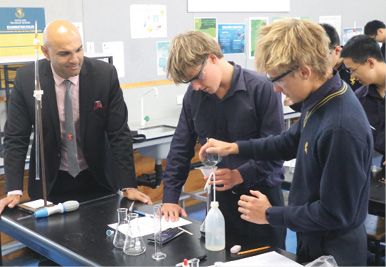
Students in a Chemistry class Students in a Physics class

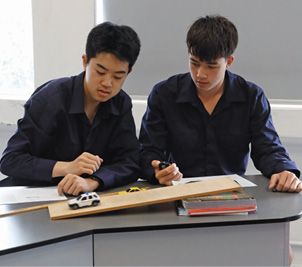
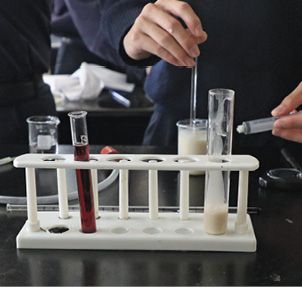
Left: Head of Chemistry Sunit Keshwara observing senior students in his Chemistry class. Right: learning about motion in a Pre-Q Physics class.

Barbara McGowan, Head of Faculty Science, answers some questions about a faculty she is hugely passionate about.

Firstly, what is your personal background with science?

I completed a BSc in Molecular Biology and Genetics and a BA (Hons) in Sociology at Victoria University of Wellington. The best thing about a conjoint degree programme is the range of papers you get to take across multiple faculties — I was exposed to different ways of approaching knowledge and gathering information to form conclusions.

I then did a teaching diploma at Auckland College of Education, focusing on Science and Biology. Here at Auckland Grammar School, I mostly teach Biology, Junior Science and Earth and Space Science. I have also taught Chemistry at AS level and Pre-Q Physics — learning chemistry and physics again has reminded me of what it's like to be a student and improved the way I teach my core subjects.

Are other science teachers as passionate as you?

Yes! The Science faculty is amazing to work with. It is unusual to get to work with so many people who are passionate about science and encouraging students to study it at a higher level. The faculty is large; we have 33 full-time science teachers, two teachers who teach science and another subject, two teacher trainees, and five technical staff. Science is strong here — it is almost like teaching in a science academy!

What is the Science pathway and what do students learn?

All students at Grammar study Science in Forms 3 and 4, giving them a strong foundation for senior science study. In Form 5, there are a range of science options, as well as Triple Science, where students take Biology, Chemistry and Physics in two option lines so they can take an extra subject at Pre-Q. In Forms 6 and 7, students can choose Biology, Chemistry and Physics in the Cambridge and NCEA pathways; NCEA students can also study Earth and Space Science. The most capable students take scholarship examinations, and join Olympiad teams and the NZYPT (New Zealand Young Physicists' Tournament).

Biology — the living world

Biology explores the diversity of life and how organisms interact with their environments. Students study life processes, evolution, and ecology, with a special emphasis on our unique ecosystems, learning to make informed decisions around sustainability and biological issues.


A container used in a Biology class A teacher working at a table in a Biology lab

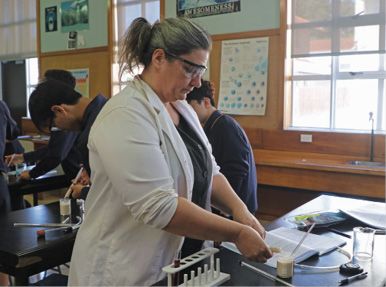
Head of Faculty for Science — Barbara McGowan working with her Biology students.

Chemistry — the material world

Chemistry investigates the composition of matter and the energy involved in its transformations. Students learn to interpret the world through the behaviour of atoms, molecules, and ions, using scientific symbols and conventions — knowledge that helps them tackle global challenges like environmental sustainability and the development of new medicines and materials.

Physics — the physical world

This strand explains phenomena such as light, sound, electricity, and motion through the central concept of energy transformation, helping students engage with contemporary technological solutions and scientific challenges.

Earth and Space Science — planet Earth and beyond

Students explore the interconnecting systems of the Earth and the wider universe. By studying how the geosphere, hydrosphere, atmosphere, and biosphere depend on one another, students realise our role as guardians of finite resources.

How well do Grammar students do?

Over 90% of students choose to continue with at least one science in Form 5. In the 2025 Cambridge pathway for A Levels, an A–C grade was gained by 85% of Chemistry students, 83% of Physics students and 77% of Biology students studying A2. NCEA Level 3 achievement standards were gained by 78% (Biology), 77% (Chemistry), 64% (Earth and Space) and 58% (Physics) of students. Scholarships were awarded to 27 (Chemistry), 22 (Physics), 13 (Biology) and two (Earth and Space) students.

Why study the sciences?

The sciences encourage you to look at the world around you and question how it works — to look at things more closely and to step back and see human endeavours occurring within a much broader lens of how the living and non-living world interact. Given the increasing role of science in addressing big issues like climate change, it's important that everyone has a strong foundation in scientific concepts so they can make informed decisions.